First Encounters with Internet Technology

The following post is my essay I submitted for peer review for my Coursera course, Internet History, Technology, and Security by Charles Severance. The question to be answered: Write an essay about how you first encountered the Internet or an earlier networking technology. Describe the technologies you were using, some of the activities you did “on line”, and tell us how having a new form of communication changed the way you think about the world.

The first two weeks of the course have been an enjoyable stroll down technology memory lane. If you are interested I believe you can still get in the course. Here is my essay:

I was a young chemist sparked by the discovery of computer programming at the end of my college career and then ignited with the purchase of an Apple II computer in 1979. My obsession with this new computational freedom motivated me to open my own computer store with a college buddy in 1980.

Scientific Frontiers Grand Opening 1981

Computer Store Looks to Future

I was programing on an HP 85 and we sold mostly CP/M based computers. Commodore emerged as our main microcomputer product line. A product that we tried to sell which I totally believed in was the “The Source”, it may have been the first online consumer service. Readers Digest believed in this enough to pay 6 million for the service in 1980. It was touted as a self-help service with a Google type dream search of that time. Access to the UPI newswire and conceptually encyclopedia type information had me believing it would change the world. However, technology was based on 300 or maybe 1200 baud acoustic modems with very few local call options. The cost per line of knowledge never built an acceptable ROI, but I do believe we saw the future. I still have one of the coffee mugs that we gave away for promotion.Source Mug

During the same period of time when I owned the computer store I travelled to Las Vegas to attend “Comdex”, pretty sure it was the fall of 1981. I was mostly interested in the battle lines that were forming between Apple and this new IBM PC. But at that show I remember checking out the Xerox Star workstation, famous for presenting the concept of the Graphical User Interface. I was impressed but did not get it. I remember scoffing at the idea of linking your hand via a mouse to activity on the computer screen. Oh well, I was not as imaginative as the Steve Jobs who did see the potential.

After the computer store and a fling with the Oil Shale boom and bust, my career moved to Hewlett-Packard, Silicon Valley, in 1987. I was in heaven, driving through the bay area at that time was like perusing a live PC Magazine. By then I believed in Windows and actually did a lot with HP’s New Wave interface. The Bay area was exciting up until the earthquake in 1989. That combined with the effect of California’s Proposition 13 on public school funding caused me to request that HP move my young family to Cincinnati in 1990. I was a systems engineer supporting the LIMS and LAS market segment, that is Laboratory Information and Instrumentation Management which matched well with my chemistry background. My early viewpoint of the “Internet” was shaped by how great the open access to DOS and Windows apps via the BBS services had become. Do you remember the “Wildcat BBS” software that was the engine for most of those services?

Access to the BBS services in the early 90’s was exploding into viable business opportunities. I used to maintain a “Best of the BBS Apps” floppy disk where I would store the coolest PC tools and screen savers of the day. I would always be asked by my customers for the latest copy of that diskette. The Hayes Smartmodem was reliable, affordable and fast enough to open the door for the geeks of the day to explore the potential of this new world of information. This reminds me of the second technology opportunity that “I did not get”. It was probably late 1992 when a co-worker of mine in Cincinnati was involved with a BBS out of Dayton, OH. He asked me one day if I would be interested in an opportunity to link his BBS to ARPANET a connection he had via a friend at Wright-Patterson Air Force Base. There was some cost involved and as I remember access was limited to a small number of users, but my question was more about what value ARPANET would provide. I could envision the potential of public access to what the academic community was playing with and open source collaboration seemed to be alive and well. I didn’t see how a path through ARPANET was going to help. But it wasn’t about ARPANET it was about seeing the potential of what soon became the World Wide Web, WWW. We were actually talking about developments taking place in this arena since we were playing with the early concept of HTML and the MOSAIC project in our X-Terminal environment.

It is fun to look back and second guess. There were lots of winners and losers. Remember Ashton-Tate’s dBASE or VisiCalc? I never thought Microsoft would amount to anything and with respect to the Internet they really didn’t. I remember how brilliant I thought Bill Gates approach was to the Internet in wanting to carve out a cost per transaction. Trouble is he never could gain control of the connection. Oh well, it was fun writing this assignment for my Coursera course “Internet History, Technology, and Security” and I am definitely interested in how this peer review grading is going to work.


The Best STEM Graduates in the World

I have been at my new university for about a month trying to assess a constant flow of data about how and why everything is as it is. My overall observation is that it is good, but that has a lot to do with the fact that my world renown science and technology university does not worry about the same challenges facing much of the rest of higher education today. What we deliver is highly valued in our technological world even if we are using a century’s old pedagogical approach.

We do have modern pedagogical teaching and learning success stories here at S&T, but we also have excellent traditional course delivery of science and engineering classes that do not need to be adjusted. So why do we also find ourselves pressured to offer more blended and online courses? Because unfortunately most of us fit into a much larger higher education structure that will be pushed and pulled by many reactions, some of which are “knee jerk” in nature. But that is OK, we must all ultimately be responsible for our own response.

I mention these early observations in my new job as sort of a preview to what I believe will be an amazing journey that I will share will my talented faculty and highly motivated EdTech team as we adapt to the changing world of higher education. Our greatest challenge may be to understand that even though change is not required it is also not bad. If our typical highly motivated STEM students are coming to us from a different culture then maybe changing our pedagogy a bit to compliment their learning preferences could be a way to make our end product even better. The challenge that brought me to S&T was not to save them but to have an opportunity to improve them. On the world stage today I see the real challenge for the United States is not just to produce more STEM graduates but to produce the Best STEM graduates. So maybe I get a chance to help change the world.

Finally admitting that we are under attack from China

Cyber attacks sure do seem to be on the increase as well as getting more sophisticated. Finding out today that Educause has experienced a security breach motivated me to offer up a post. Is anyone surprised by the attacks being traced back to the Chinese Army. Those of us with systems under attack have known for a long time where most of the serious traffic was coming from. And although we did not have a specific building in Shanghai, however, we did know that attacks were originating in China. I guess they finally went too far and the Pentagon had to go public with the story. Of course the official report issued by the security firm Mandiant Technologies could not be ignored especially after the New York Times hack was made public.

The cyber attacks were not sophisticated direct penetration attacks but instead just very well done phishing attacks. Phishing as in tricking users into allowing their account passwords to be discovered. The White House and many universities in our country, mine included, were heavily targeted by spear-phishing attacks in the Fall of 2012. The results of these compromised accounts translated into massive use of our email servers to send out Spam email. This turns out to be a very profitable product for the successful hackers. However, the positive outcome from these attacks is that our university is now willing to get far more serious about implementing stronger security measures. Leading the way will be a stronger password change policy. But the real reason for changing passwords is to protect us against the compromises we do not know about.

Reflecting on my trip East so far

I will blame not posting on my transition between jobs but I find myself in a hotel room in Rock Springs, WY on my way across America with some time for reflections. I am driving my beloved car from Oregon to Missouri via Denver where I will take in the ELI Conference on the 4-6. This Western half of the trip brings back many memories for me.
Leaving the Portland area through the Columbia River Gorge reminded me of the trip I took in the opposite direction in 2004 when I came to Oregon and George Fox University. What a dramatic portal it provides to the Northwest. I was extremely thankful that my trip east on a good highway was so much easier then Lewis & Clark had to deal with. I reference this concern because my entire trip in the heart of winter is a bit precarious in an Acura RSX that looks more like a snow drift to the trucks and snow plows that I have been dodging. Yes the Blue Mountains with snow packed roads kept me a bit tense. As I approached Salt Lake City with a plan to work my way down to I-70 for rendezvous with colleagues in Grand Junction, I had to abort due to a pesky storm hitting the area. Luckily diverting to I-80 worked out well and allowed me to reminisce about my earlier life in Mine Engineering and Electric Power Generating out of NW Colorado.
Rock Spring, WY, an oasis for coal miners in one of the harshest environments in the US. It is about 30 F and the wind is blowing 40 mph as it typically does. But there is coal in these parts and rivers to set power plants next to. Now they have added wind powered generators so there is plenty of electricity flowing out of this desolate place helping to light the cities of the West. Tomorrow I hope to make it to Steamboat Springs, assuming their recent 2 feet of snow does not stop me. There are still good friends and lots of memories there.

Continental Divide between I-80 and Baggs, WY

Continental Divide between I-80 and Baggs, WY

Update: I tried to get to Steamboat Springs but turned around at the Continental Divide on the road to Baggs, WY. Glare ice, 40 mph wind and big trucks caused me to reevaluate the risk/reward and decided to drive to Denver via I-80. The next day I did get to go Fly fishing on the head waters of the South Platte near Decker, CO. And yes, I caught a nice trout.

Final update, I did make it to Rolla. Bought a house the first day, love S&T and Rolla, MO.

Impending Disruption to Higher Education

I have spent a lot of time in the last week thinking about what disruption to Higher Education will really look like. I got to spend some time with Richard DeMillo after I read his book, “Abelard to Apple“. The book is an excellent review of what Higher Ed was and in some cases still is. And Richard offers sound ideas about the obvious need to adapt education to our current information rich world. What struck me was that he identified the significance of MOOCs before they had evolved as we see them today under flags of Coursera, Udacity and edX.

DeMillo was a guest speaker for our NWACC Summit which happened to be our 25th anniversary with a major strategic planning purpose. So it also surprised me that discussion amongst the 30+ CIOs from the Northwest also focused heavily on the ramifications of the MOOCs. You see MOOCs are not the disruption, they are just exposing the problems so that we will finally need to deal with the disruption that is already upon us. Many have chosen to focus on the MOOCs themselves, determining how they will inevitably fail to compete academically and with respect to profitability. But it is not about the MOOCs succeeding in our traditional measures. The MOOCs have been funded by venture capitalists who tend to know when a profit is to be made and the Monetization value of MOOCs is starting to become clear. Exposure brings fame and fortune and access to valuable data or clients does as well. Coursera Career Services is not just about about helping their students find a job. I believed for many years that there was no way Amazon could ever make a profit, now I realize there are bigger forces at play.

The disruption comes from the MOOCs exposing the weakness of our traditional Higher Education course and degree delivery system. An obvious threat comes from the career service aspect. That is a domain that Higher Ed needs to control. Our degrees need to be the preeminent standard for validation that learning has  been accomplished. At the foundation of our system is the credit hour. The Carnegie Foundation for the Advancement of Teaching announced this week that it is rethinking the value of the Carnegie Unit for which we have defined the credit hour. Higher Education; we need to respond to this disruption with innovation rather then denial.

Good Look at our iGFU Mobile Portal

Our student News team wanted to do a story on our iGFU Mobile Portal. They tried to video record a demo off of an iPAD which was not going to work so iGFU author, Brian McLaughlin, made them a simple tutorial that we now use on our website. Checkout the tutorial if you have any interest in what a university mobile portal needs to be. Remember, our mobile portal is basically a skunk works project that leverages the flexibility and performance of HTML5 using Java and PHP to access useful data from general data feeds, Moodle and our PeopleSoft ERP.

The tutorial also highlights a couple of other useful tools. Brian made the video by using an App called AirServer that allows him to mirror an IOS device to his MacBook. He then records it with Quicktime and with a little editing on iMovie you get a very real view of a mobile app. Then we upload the video to our new ShareStream video distribution system which gives us total flexiblity to manage and distribute video (especially if we want to manage copyright). We are investigating if AirServer might offer a better path for iPad mirroring to projector in the classroom.

Redesigned Our IT Website

I thought I should give a recap of our departmental website redesign project. Many of you have responsibility for a website or at least content on a website. For some this is natural but for many it is difficult to maintain. If like my job, you are responsible for a website that is the portal to services needed by your constituents then it needs to be an effective site for navigating to the desired answer. Our IT website was basically created from a general university design back when we implemented a new CMS solution. It was not terrible but it was not thought out either with respect to usability. But who has the time or interest to tackle such a problem. Inevitably I did have to tackle this, so at the beginning of the year I posed the question to our CIO listserv if anyone could suggest good Higher Education IT Websites. Got some good feedback and gravitated to the IT website of the University of Chicago. I like their quick access icons and organization based on function rather then role.

GFU IT Logo

GFU Website

We borrowed some of the design features from the UC site and began working with our Marketing department to design a new IT website theme. We use Cascade Server from Hannon Hill so we needed to translate our ideas and let them give us a prototype. With a basic design and goals for the various navigation strategies we involved many of our IT staff in translating our current website to the new design. Of course we came up with some new pages but mostly it was a redefinition of the purpose and style for conveying the same information. Of course we had some superstars who really helped us organize it. All this leads to a pilot site that you try to get everyone to update and validate.But at some point you have to say launch and once you get close it is probably better to launch. Mistakes on the production website that your department has taken project ownership of is a good motivator to make sure it is ready for the launch. I know that was a very general recap of a process many go through but I can say that it appears our site is a great improvement over the past. We offer quick tabs (icons) for the most requested services. We have functional service areas and then we keep a running sidebar menu for a little of both.

BTW – checkout our video about IT Services on the Home Page of our Website

Year of the Mobile Portal

This year we realized that our mobile portal was ready for some real marketing. I guess up until now we were content to let our customers discover it and utilize it as they desired. What we came to realize was that way to many of our customers had never heard of our mobile portal. How could that be, isn’t IT and the services IT provides at the center of all that happens at a university??? Actually our mobile portal iGFU.georgefox.edu has received a lot of accolades mostly from Oracle Higher Education folks since we have done a great job in leveraging our PeopleSoft data for useful mobile services. So maybe it is better known outside of our university. Recently a couple of our iGFU developers were recognized by NWACC and given an Exemplary Practice Award.

This year we are actually promoting iGFU and usage stats this first week show us that most everyone may finally be using it. We have opted for some promotional gimmicks like allowing our food service provider or bookstore to offer deals that can only be redeemed on someone’s smart mobile device. This new IT Video promotes a number of services that IT provides including iGFU.The most common hits are for class schedule information right now but the administrative services especially for academics are receiving a lot of praise. The class roster service spawns options for a professor to communicate with their class, offer a survey, view photos of individuals or the entire class (on a Pad or Computer display), monitor Moodle Class Forums, show student’s major,  and academic advisor(s).

iGFU Faculty MyGFU Screen

iGFU Faculty MyGFU Screen

Information for a specific course provides all the normal course description, books required and the syllabus if available. Course schedules show you what you have today as well as for the rest of the week. Students can map their Moodle assignment schedules into their Google Calendar, and the list goes on. The real key here is that if a Professor asks for something we always seem to be able to deliver with limited complexity. The administrative side of iGFU has also grown with services. The live budget update service has generated the most praise but another useful feature allows our development officers to lookup their prospects complete with all of their notes. Zoom into the prospects house with the linked Google Earth and certain priorities can be considered.

The bottom line is that our mobile portal has redefined what efficient presentation of data should look like. The directory lookup feature is now a standard page open on most of our administrator’s desktops. A major advantage which makes the mobile portal much more effective is how we can easily use our role based access structure from PeopleSoft to customize what each user is presented. So that is enough bragging about iGFU.

Thanks to recognition from Oracle it is not uncommon to be contacted by another university asking about how we created iGFU. Why go with a web design vs. and app design? How were we able to approve features with typical university committees. How were we able to access so much data from our ERP?

Going with the web design is the obvious choice if you want rapid and flexible deployment and no hassle device deployment. If you design your data access efficiently then performance is not an issue. This more then justifies the loss of some native app features. But the real key to our success comes from the design and development strategy. The most important design strategy is whether we are create something that would be useful for someone walking from lunch to class. Also no committees deciding or designing features. My key developer happens to be my DBA, so in his words he is able to accomplish so much because he holds the keys to the kingdom. He would never let another programmer gain so much access to the database. I let my developers respond directly to feature requests. They crank out another feature and we decide within IT whether it is acceptable for release and then we get appropriate pilot feedback if it deals with access control. But mostly we quickly turn around requests and fine tune a feature based on real user feedback.

This all may sound to simplistic but that is the key to a successful mobile portal. Of course talented programmers with great development tools working from a clean ERP system designed for web clients makes the job a whole lot easier. But any university holds the data necessary to build an effective mobile portal, finding some development talent empowered by some creative freedom could also release these mobile services to your customers. If you do not have the resources to develop a mobile portal yourselves then you may want to consider a couple of commercial option focused on PeopleSoft: HighPoint or BASHmobile

Faculty Conference Kicks Off the New Year

We held our faculty “Kick-off the Year” conference yesterday and I would say it was a great success considering it was the first time in many years that we did not hold the conference down at the coast. The focus of the conference was about incorporating various aspects of technology in support of teaching. We had a great keynote speaker in Bill Rankin from Abilene Christian University. His talk “Flights of Discovery: Transformation in Third-Age Education” sufficiently conveyed that we need to change our way of dealing with this Data driven era, “But How”. Plenty of good examples about how students are learning more with real world experience and less in old world classroom lectures. But how might we change this? I pitched the services that my IT department provides for our faculty but we don’t come close to offering the resources that they really need. This video touches on the less obvious.

I listened to our faculty ask great questions about how they might engage or inspire their students. Sure the use of technology could help, especially shifting to a more blended learning approach, but that is not the total answer. My take-away was that we can only do the best we can under the current structure. And by structure I mean classes delivered in a weekly schedule over a semester type period of time. Sure it would be great if our Social Sciences courses could hold class in a homeless shelter in downtown Portland, but that doesn’t work in this structure. So then I contemplated different structures like courses meet for a week at a time a few times through the semester, but that does not work. When you have many students all trying to piece together a schedule that accommodates all their needs and the needs of all the other students and faculty we end up with what we have. What would it take to really shake this up? I’m not sure but I think it may involve tearing down that structure. Maybe redefine what a class is altogether. Yikes, a bit scary but you know, it may be worth exploring.

Annual Backpacking Trip

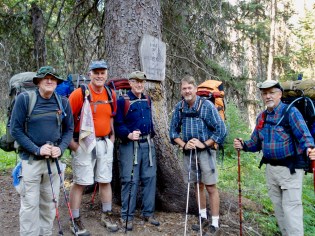
This year we travel to NE Oregon to begin our annual 5 day backpacking trip. EagleCap2012 - OldBackpackersThis year I have 4 other men joining me and we will be hiking in the Eagle Cap Wilderness through the Wallowa Mountains. The trip is based on a loop but incorporated a few days for side loops.

EagleCap2012 - GregBlueLake

Blue Lake

The wilderness beauty was beyond what I expected. All five of us started from Two Pan Trailhead heading up the Minam Lake Trail, spending 2 nights at Minam Lake with a day trip over to Blue Lake. Minam lake provided swimming, fishing and serious relaxation. We were even treated to a sunset on the second evening.

Minam Lake

Three of us continued over over the 8548′ Carper pass on the Ivan Carper Trail #1661 into the Lakes Basin. The climb is challenging and mostly exposed.


EagleCap2012 - Lakes Basin

We passed by Mirror Lake and ended up camping at Moccasin Lake planning on a few nights with days hikes and more fishing. We hiked the Basin Lakes loop over by Douglas Lake and back.

This slideshow requires JavaScript.

My buddies were tired but I felt like I needed to see Glacier Lake up above in front of Eagle Cap. This solo climb to Glacier Lake was the ultimate highlight for me. Here is a glimpse.

Glacier Lake - Eagle Cap

Glacier Lake – Eagle Cap

You could incorporate a loop up past Glacier Lake down to the Frazier Lakes and back around to the Lakes Basin area.

EagleCap2012 - StreamOutOfGlacierLake

Stream from Glacier Lake Heading Down to the Frazier Lakes

We ended this awesome trip by hiking out along the East Fork of Lostine Trail #1662.

East Fork of Lostine

East Fork of Lostine