The following post is my essay I submitted for peer review for my Coursera course, Internet History, Technology, and Security by Charles Severance. The question to be answered: Write an essay about how you first encountered the Internet or an earlier networking technology. Describe the technologies you were using, some of the activities you did “on line”, and tell us how having a new form of communication changed the way you think about the world.
The first two weeks of the course have been an enjoyable stroll down technology memory lane. If you are interested I believe you can still get in the course. Here is my essay:
I was a young chemist sparked by the discovery of computer programming at the end of my college career and then ignited with the purchase of an Apple II computer in 1979. My obsession with this new computational freedom motivated me to open my own computer store with a college buddy in 1980.

Computer Store Looks to Future
I was programing on an HP 85 and we sold mostly CP/M based computers. Commodore emerged as our main microcomputer product line. A product that we tried to sell which I totally believed in was the “The Source”, it may have been the first online consumer service. Readers Digest believed in this enough to pay 6 million for the service in 1980. It was touted as a self-help service with a Google type dream search of that time. Access to the UPI newswire and conceptually encyclopedia type information had me believing it would change the world. However, technology was based on 300 or maybe 1200 baud acoustic modems with very few local call options. The cost per line of knowledge never built an acceptable ROI, but I do believe we saw the future. I still have one of the coffee mugs that we gave away for promotion.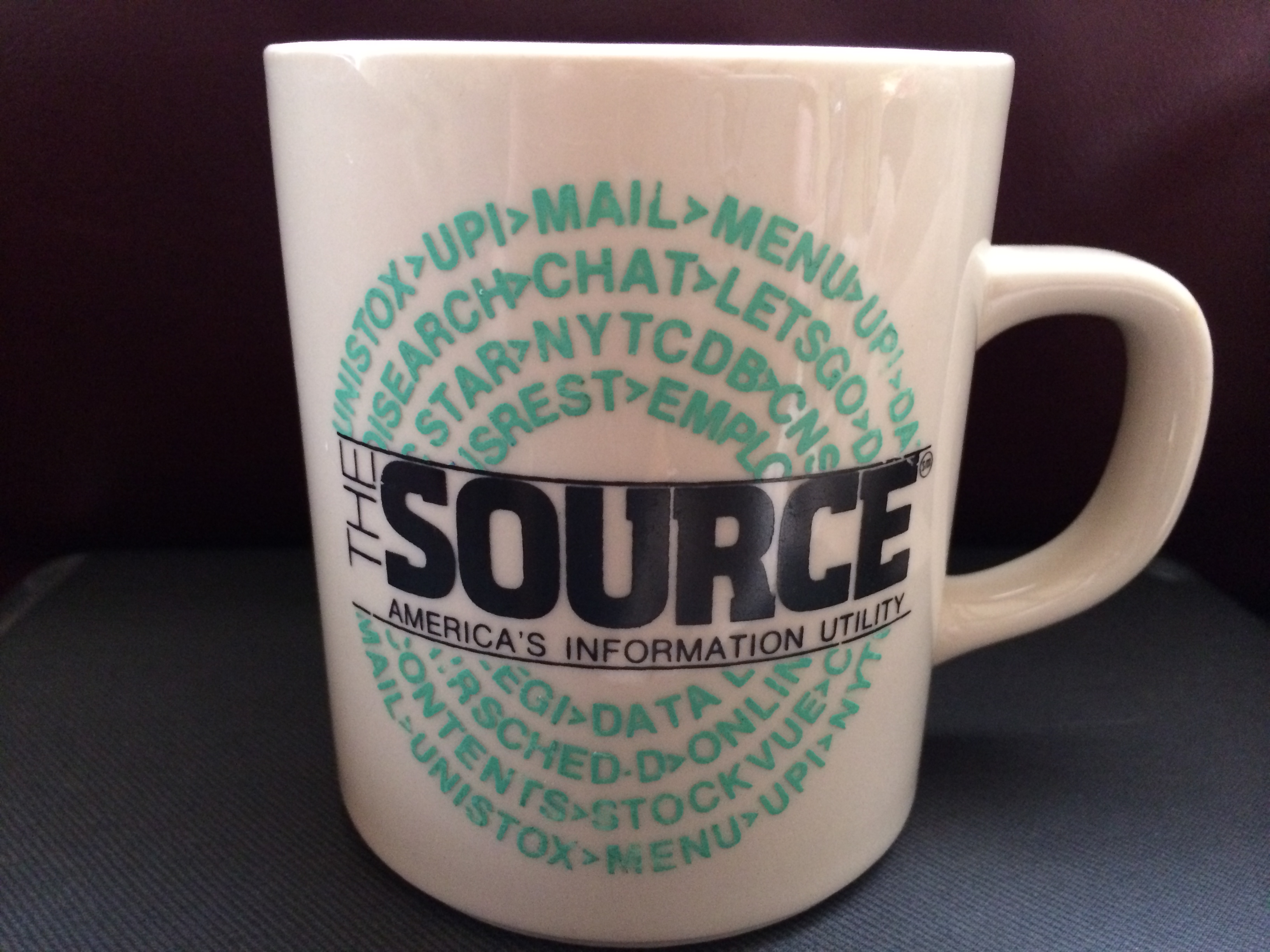
During the same period of time when I owned the computer store I travelled to Las Vegas to attend “Comdex”, pretty sure it was the fall of 1981. I was mostly interested in the battle lines that were forming between Apple and this new IBM PC. But at that show I remember checking out the Xerox Star workstation, famous for presenting the concept of the Graphical User Interface. I was impressed but did not get it. I remember scoffing at the idea of linking your hand via a mouse to activity on the computer screen. Oh well, I was not as imaginative as the Steve Jobs who did see the potential.
After the computer store and a fling with the Oil Shale boom and bust, my career moved to Hewlett-Packard, Silicon Valley, in 1987. I was in heaven, driving through the bay area at that time was like perusing a live PC Magazine. By then I believed in Windows and actually did a lot with HP’s New Wave interface. The Bay area was exciting up until the earthquake in 1989. That combined with the effect of California’s Proposition 13 on public school funding caused me to request that HP move my young family to Cincinnati in 1990. I was a systems engineer supporting the LIMS and LAS market segment, that is Laboratory Information and Instrumentation Management which matched well with my chemistry background. My early viewpoint of the “Internet” was shaped by how great the open access to DOS and Windows apps via the BBS services had become. Do you remember the “Wildcat BBS” software that was the engine for most of those services?
Access to the BBS services in the early 90’s was exploding into viable business opportunities. I used to maintain a “Best of the BBS Apps” floppy disk where I would store the coolest PC tools and screen savers of the day. I would always be asked by my customers for the latest copy of that diskette. The Hayes Smartmodem was reliable, affordable and fast enough to open the door for the geeks of the day to explore the potential of this new world of information. This reminds me of the second technology opportunity that “I did not get”. It was probably late 1992 when a co-worker of mine in Cincinnati was involved with a BBS out of Dayton, OH. He asked me one day if I would be interested in an opportunity to link his BBS to ARPANET a connection he had via a friend at Wright-Patterson Air Force Base. There was some cost involved and as I remember access was limited to a small number of users, but my question was more about what value ARPANET would provide. I could envision the potential of public access to what the academic community was playing with and open source collaboration seemed to be alive and well. I didn’t see how a path through ARPANET was going to help. But it wasn’t about ARPANET it was about seeing the potential of what soon became the World Wide Web, WWW. We were actually talking about developments taking place in this arena since we were playing with the early concept of HTML and the MOSAIC project in our X-Terminal environment.
It is fun to look back and second guess. There were lots of winners and losers. Remember Ashton-Tate’s dBASE or VisiCalc? I never thought Microsoft would amount to anything and with respect to the Internet they really didn’t. I remember how brilliant I thought Bill Gates approach was to the Internet in wanting to carve out a cost per transaction. Trouble is he never could gain control of the connection. Oh well, it was fun writing this assignment for my Coursera course “Internet History, Technology, and Security” and I am definitely interested in how this peer review grading is going to work.


