Category Archives: academic
Good Look at our iGFU Mobile Portal
Our student News team wanted to do a story on our iGFU Mobile Portal. They tried to video record a demo off of an iPAD which was not going to work so iGFU author, Brian McLaughlin, made them a simple tutorial that we now use on our website. Checkout the tutorial if you have any interest in what a university mobile portal needs to be. Remember, our mobile portal is basically a skunk works project that leverages the flexibility and performance of HTML5 using Java and PHP to access useful data from general data feeds, Moodle and our PeopleSoft ERP.
The tutorial also highlights a couple of other useful tools. Brian made the video by using an App called AirServer that allows him to mirror an IOS device to his MacBook. He then records it with Quicktime and with a little editing on iMovie you get a very real view of a mobile app. Then we upload the video to our new ShareStream video distribution system which gives us total flexiblity to manage and distribute video (especially if we want to manage copyright). We are investigating if AirServer might offer a better path for iPad mirroring to projector in the classroom.
Year of the Mobile Portal
This year we realized that our mobile portal was ready for some real marketing. I guess up until now we were content to let our customers discover it and utilize it as they desired. What we came to realize was that way to many of our customers had never heard of our mobile portal. How could that be, isn’t IT and the services IT provides at the center of all that happens at a university??? Actually our mobile portal iGFU.georgefox.edu has received a lot of accolades mostly from Oracle Higher Education folks since we have done a great job in leveraging our PeopleSoft data for useful mobile services. So maybe it is better known outside of our university. Recently a couple of our iGFU developers were recognized by NWACC and given an Exemplary Practice Award.
This year we are actually promoting iGFU and usage stats this first week show us that most everyone may finally be using it. We have opted for some promotional gimmicks like allowing our food service provider or bookstore to offer deals that can only be redeemed on someone’s smart mobile device. This new IT Video promotes a number of services that IT provides including iGFU.The most common hits are for class schedule information right now but the administrative services especially for academics are receiving a lot of praise. The class roster service spawns options for a professor to communicate with their class, offer a survey, view photos of individuals or the entire class (on a Pad or Computer display), monitor Moodle Class Forums, show student’s major, and academic advisor(s).
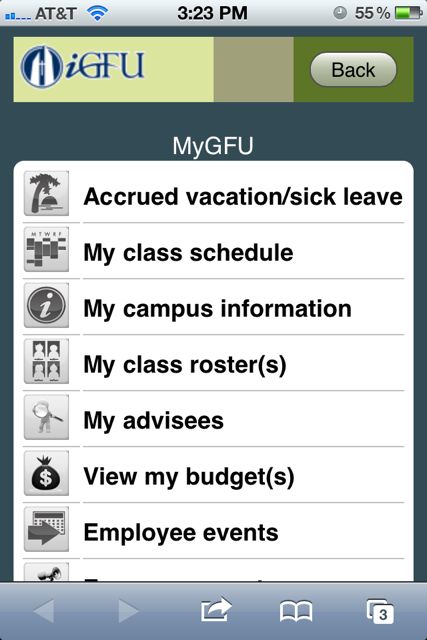
iGFU Faculty MyGFU Screen
Information for a specific course provides all the normal course description, books required and the syllabus if available. Course schedules show you what you have today as well as for the rest of the week. Students can map their Moodle assignment schedules into their Google Calendar, and the list goes on. The real key here is that if a Professor asks for something we always seem to be able to deliver with limited complexity. The administrative side of iGFU has also grown with services. The live budget update service has generated the most praise but another useful feature allows our development officers to lookup their prospects complete with all of their notes. Zoom into the prospects house with the linked Google Earth and certain priorities can be considered.
The bottom line is that our mobile portal has redefined what efficient presentation of data should look like. The directory lookup feature is now a standard page open on most of our administrator’s desktops. A major advantage which makes the mobile portal much more effective is how we can easily use our role based access structure from PeopleSoft to customize what each user is presented. So that is enough bragging about iGFU.
Thanks to recognition from Oracle it is not uncommon to be contacted by another university asking about how we created iGFU. Why go with a web design vs. and app design? How were we able to approve features with typical university committees. How were we able to access so much data from our ERP?
Going with the web design is the obvious choice if you want rapid and flexible deployment and no hassle device deployment. If you design your data access efficiently then performance is not an issue. This more then justifies the loss of some native app features. But the real key to our success comes from the design and development strategy. The most important design strategy is whether we are create something that would be useful for someone walking from lunch to class. Also no committees deciding or designing features. My key developer happens to be my DBA, so in his words he is able to accomplish so much because he holds the keys to the kingdom. He would never let another programmer gain so much access to the database. I let my developers respond directly to feature requests. They crank out another feature and we decide within IT whether it is acceptable for release and then we get appropriate pilot feedback if it deals with access control. But mostly we quickly turn around requests and fine tune a feature based on real user feedback.
This all may sound to simplistic but that is the key to a successful mobile portal. Of course talented programmers with great development tools working from a clean ERP system designed for web clients makes the job a whole lot easier. But any university holds the data necessary to build an effective mobile portal, finding some development talent empowered by some creative freedom could also release these mobile services to your customers. If you do not have the resources to develop a mobile portal yourselves then you may want to consider a couple of commercial option focused on PeopleSoft: HighPoint or BASHmobile
Faculty Conference Kicks Off the New Year
We held our faculty “Kick-off the Year” conference yesterday and I would say it was a great success considering it was the first time in many years that we did not hold the conference down at the coast. The focus of the conference was about incorporating various aspects of technology in support of teaching. We had a great keynote speaker in Bill Rankin from Abilene Christian University. His talk “Flights of Discovery: Transformation in Third-Age Education” sufficiently conveyed that we need to change our way of dealing with this Data driven era, “But How”. Plenty of good examples about how students are learning more with real world experience and less in old world classroom lectures. But how might we change this? I pitched the services that my IT department provides for our faculty but we don’t come close to offering the resources that they really need. This video touches on the less obvious.
I listened to our faculty ask great questions about how they might engage or inspire their students. Sure the use of technology could help, especially shifting to a more blended learning approach, but that is not the total answer. My take-away was that we can only do the best we can under the current structure. And by structure I mean classes delivered in a weekly schedule over a semester type period of time. Sure it would be great if our Social Sciences courses could hold class in a homeless shelter in downtown Portland, but that doesn’t work in this structure. So then I contemplated different structures like courses meet for a week at a time a few times through the semester, but that does not work. When you have many students all trying to piece together a schedule that accommodates all their needs and the needs of all the other students and faculty we end up with what we have. What would it take to really shake this up? I’m not sure but I think it may involve tearing down that structure. Maybe redefine what a class is altogether. Yikes, a bit scary but you know, it may be worth exploring.
Time to Invest in Video Distribution
Video distribution is high on my priority list. We have made the most of iTunesU, our own Darwin streaming server, You-Tube, Vimeo and even Moodle. But the effort does not justify the means any more. Dealing with copyright issues is becoming more strategic and of course the overall amount of media objects being distributed has been exploding for a number of years now. We tried to conquer the OpenCast Matterhorn project, but it is not hard to figure out that open source projects either have momentum or they fade away. Plus most of the solutions that have been pitched have more of a focus on the ingestion of video for processing help. Distribution is a by-product that is typically not fully developed.
Lecture capture has been the commercial money maker with value coming from the ease of capture and production. But why would we want to capture lectures when the reason for all of this extra video is to supplement the trend toward blended learning. We have a fair investment in Camtasia so we are interested in video distribution of these Camtasia video vignettes so maybe Camtasia Relay makes sense. But I think we are really looking at a solution like Kaltura, ShareStream, MediaCast or Ensemble. And I lean toward a hosted solution since my network is not optimized for streaming nor should it be. The solution must focus on the flexibility of access control so that we can comply with copyright. A little help with video ingestion formatting would be nice but our media students are very good with that support. Option to integrate with our Moodle LMS is important. And it does not hurt for the solution to help manage other content streams like podcasts or other commercial video repositories. I will let you know what we select.
Results are in – we will be going with a ShareStream hosted solution. Our media team is very excited about moving content over to a distribution system that provides access control. The Moodle interface is good but they probably need to focus more on the major LMS in the world.
They are changing the face of education globally
I checked out Coursera’s course offerings and I have to admit they have a great lineup of quality courses. I signed up for “Introduction to Logic” from Stanford which begins soon so I could evaluate the process and quality of delivery, plus I am somewhat interested in logic. Then I signed up for “Introduction to Genome Science” from University of Pennsylvania for a fun refresher to my MS in Bioinformatics where my thesis was “Security of Our Personal Genome”. Purely continuing education but what a huge market that could be. You do realize this is wave 2 of open courseware. Coursera’s quote: We are changing the face of education globally, and we invite you to join us. Let’s assume Coursera is able to competently deliver these courses to any number of students. And let’s assume their student assessment techniques allow them to validate that learning took place. They have the prestigious of elite institutions of higher education. What does this mean?
What if a year from now millions of people are successfully completing courses through Coursera, Udacity and probably other copycat competitors. First Coursera is going to be worth billions and second a benchmark will be established that will define what is a quality online course. What will this benchmark mean? It will eliminate the argument that legitimate For-Profit online providers lack in quality. But more important it will validate the other argument that many of the online courses from traditional non-profit institutions are not worth the bandwidth you are wasting on them. So what does this mean for most of us (higher education)? Our online or blended offerings which we realize we must offer will have to be of similar quality to the free offerings from the Coursera’s of the world. We will have a benchmark. And then we just worry about holding on to our control of accreditation for validating what is a college degree and what is it worth. I am thankful that we will still have the value of the campus experience, but again, what will it be worth.
Update July 17, 2012 – More research universities join Coursera


