Time to Invest in Video Distribution
Video distribution is high on my priority list. We have made the most of iTunesU, our own Darwin streaming server, You-Tube, Vimeo and even Moodle. But the effort does not justify the means any more. Dealing with copyright issues is becoming more strategic and of course the overall amount of media objects being distributed has been exploding for a number of years now. We tried to conquer the OpenCast Matterhorn project, but it is not hard to figure out that open source projects either have momentum or they fade away. Plus most of the solutions that have been pitched have more of a focus on the ingestion of video for processing help. Distribution is a by-product that is typically not fully developed.
Lecture capture has been the commercial money maker with value coming from the ease of capture and production. But why would we want to capture lectures when the reason for all of this extra video is to supplement the trend toward blended learning. We have a fair investment in Camtasia so we are interested in video distribution of these Camtasia video vignettes so maybe Camtasia Relay makes sense. But I think we are really looking at a solution like Kaltura, ShareStream, MediaCast or Ensemble. And I lean toward a hosted solution since my network is not optimized for streaming nor should it be. The solution must focus on the flexibility of access control so that we can comply with copyright. A little help with video ingestion formatting would be nice but our media students are very good with that support. Option to integrate with our Moodle LMS is important. And it does not hurt for the solution to help manage other content streams like podcasts or other commercial video repositories. I will let you know what we select.
Results are in – we will be going with a ShareStream hosted solution. Our media team is very excited about moving content over to a distribution system that provides access control. The Moodle interface is good but they probably need to focus more on the major LMS in the world.
They are changing the face of education globally
I checked out Coursera’s course offerings and I have to admit they have a great lineup of quality courses. I signed up for “Introduction to Logic” from Stanford which begins soon so I could evaluate the process and quality of delivery, plus I am somewhat interested in logic. Then I signed up for “Introduction to Genome Science” from University of Pennsylvania for a fun refresher to my MS in Bioinformatics where my thesis was “Security of Our Personal Genome”. Purely continuing education but what a huge market that could be. You do realize this is wave 2 of open courseware. Coursera’s quote: We are changing the face of education globally, and we invite you to join us. Let’s assume Coursera is able to competently deliver these courses to any number of students. And let’s assume their student assessment techniques allow them to validate that learning took place. They have the prestigious of elite institutions of higher education. What does this mean?
What if a year from now millions of people are successfully completing courses through Coursera, Udacity and probably other copycat competitors. First Coursera is going to be worth billions and second a benchmark will be established that will define what is a quality online course. What will this benchmark mean? It will eliminate the argument that legitimate For-Profit online providers lack in quality. But more important it will validate the other argument that many of the online courses from traditional non-profit institutions are not worth the bandwidth you are wasting on them. So what does this mean for most of us (higher education)? Our online or blended offerings which we realize we must offer will have to be of similar quality to the free offerings from the Coursera’s of the world. We will have a benchmark. And then we just worry about holding on to our control of accreditation for validating what is a college degree and what is it worth. I am thankful that we will still have the value of the campus experience, but again, what will it be worth.
Update July 17, 2012 – More research universities join Coursera
Universities Moving from Elite to Unique
There must have been a press release by Coursera recently to fuel the many articles today about their new partnership with Princeton University, the University of Pennsylvania, the University of Michigan at Ann Arbor to join their charter partner Stanford. This is all about elite universities embracing massively open online courses, or MOOCs. I think this signals a major move of the changing strategy of higher education. And I think this is significant enough that all universities need to take notice and evaluate how this might affect their course delivery strategy and the future of higher education.
MIT, Harvard and Stanford have shaken things up by driving these MOOCs and in some courses offering a certificate of completion for those who have successfully participated. This is not a credential that has any official meaning, however, why doesn’t it. It can now be argued that one could present their successful completion of a series of courses from these prestigious institutions as validation that learning took place and should now offer a certain level of qualification similar to a college degree. That is extremely scary to higher education, but why not to these universities that have pioneered this MOOC strategy?
It appears from the articles that faculty at these institutions are highly motivated to participate in offering these courses that are open to students outside of their traditional classes. Maybe they are inspired by how Stanford engineering professors Daphne Koller and Andrew Ng parleyed their efforts into the startup company Coursera funded by $16M of VC money. But why are these universities so supportive? Are they jumping into this just because they can? I don’t think so, I think they understand the transition that higher education is going through and they plan on be at the front end of it. They see that that an online component for a course brings the value of the community. And they have decided to perfect this online component to ensure their leadership in leveraging these communities. Not to grow their online revenue, although that may very well be an outcome, but instead this partnership with Coursera allows them to effectively bring the world to their classrooms. If the paying students who benefit from advantages of F2F also have an opportunity to collaborate with an unlimited number of students from the world, then they win. These institutions will move beyond just “Elite” they become “Unique”.
Remembering Windows 3.1
When I saw this article “Windows 3.1 Twenty Years Later” from PC Magazine today, I asked myself, where was I and how did Windows 3.1 influence my life.

Microsoft Windows 3.1
I was working for Hewlett-Packard and the Windows based PC was our standard computing environment. Yes, we were using it to access UNIX and RTE based systems but we were also developing products that relied on Windows. And the hopes for a more stable Windows were very real for us System Engineers. We had been propping up Windows 2.0 then 3.0 with HP’s NewWave, and that computing life was not stable. We had analytical instrumentation workstation software running on Windows that had strict requirements.
Opening multiple windows gave us the false illusion that we were running multiple programs at the same time. No we were just using the windows as placeholders, but Win 3.1 gave us hope. The Windows Registry was born giving us nerds the power over the general users. Screen savers spawned an industry of gimmicky apps that in some ways rivaled todays app store. Our customers were so excited when we would pass along the latest new screen saver apps that we had pulled off some BBS. I guess Win 3.1 also ushered in the Golden Age of Microsoft. We then got Win 3.11 or Windows for Workgroups. Remember how amazing the concept of sharing files between PCs was. We knew that true multi-tasking was on the horizon.
Oh well, that was fun, just felt like sharing those memories.
Redesigning our Wireless Network for BYOD
I’m giving a presentation next week at a technology conference for higher education technology leaders entitled “Redesigning Wireless Networks for the Proliferation of Multimedia Enabled Mobile Devices”. What will be valuable about my presentation won’t be details about wireless network technology, although some details will be used to seed the conversation. No, the value will be the open discussion about what we are doing with our wireless networks and why we feel we need to do it. A discussion that invariably takes us to how we will deal with the influx of BYOD, Bring Your Own Device, to our campuses.
The BYOD buzz is helpful to the vendors and consultants to generate concern about this proliferation of wireless personal computing devices on our campuses. We may just deal with this as a policy decision of (Not Allowed) hoping to maintain control of our network. But we will eventually need to deal with this. However, our infrastructure may not be ideally designed for the challenge. The solution is now pointing to a new version of Network Access Control, NAC. Not the NAC of virus quarantine days but a NAC for designed for wireless network management.
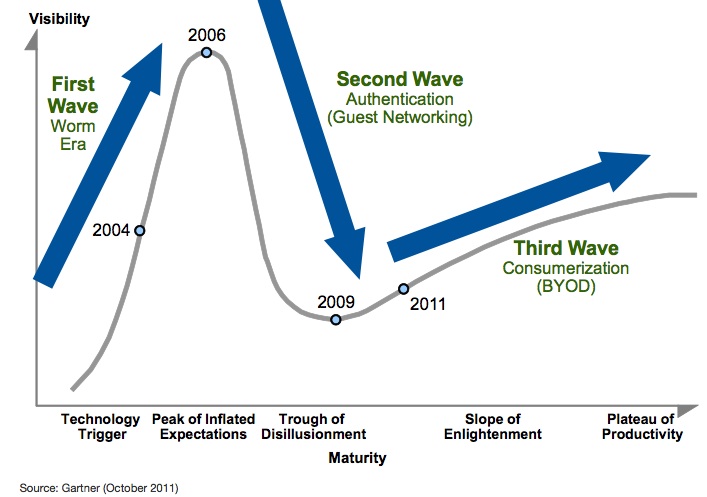
I believe that our wireless network has become the primary network access. This means we can’t wait to negotiate authentication and provisioning back at the network core, we need to make those decisions at the point of access. There may be wireless devices that we do not want on our network and there is enough information to make that decision before any access is granted. Our user classes are no longer just employees and guests, we need to offer role based policy management. Wireless service is now about seamless handoffs as one moves across campus and bandwidth allocation from multiple access points with multiple antennas. Responding to these wireless networking requirements is not just about a financial investment. The correct strategic decisions are more critical then ever as we try to position ourselves for the next wave of innovation destined for our campuses.
We can do more Good in Cameroon

GeoAid crew in Lomie, Cameroon
It is time for me to document my experience here in Cameroon. I leave for the US on a red eye tonight with a day layover in Paris. Cameroon is referred to as “Little Africa” because it has a bit of all Africa throughout this small country located in the hinge of Africa. The country is half English speaking and half French which is primarily where I was visiting. I experienced the city and the jungle and both are unique but really not desirable. The best thing that can be said about Cameroon is that the country is politically stable and free of violence. But it is a country that does not have a lot going for it nor does it appear they care. The power players in the city are either government or NGOs dominated by UN aid organizations. The jungle or the Eastern province where my GeoAid is focused is the backwoods of any Cameroonian concern. Aid from any entity trickles to nothing by the time you reach the edge of civilization. The last outpost is the town of Lomie where GeoAid resides thanks to our partnership with the rapidly downsizing GeoVic mining operation.

People of Lomie
I explained briefly why I am involved with GeoAid in my previous post, after this visit I am better able to evaluate our situation and advise our Board about the future strategic direction for GeoAid. That strategy, with respect to Cameroon, is focused on new corporate partnerships which is coming together just fine. Those partnerships will be about social responsibility for communities affected by their corporate activity, for which GeoAid is positioned as well as any NGO in Cameroon. But I have also been touched by the work that we have done in the Lomie area and realize that we need to maintain that base regardless of a local corporate connection. We have a connection to the people there and unfortunately they desperately need our support. There are some religious based missions and some Peace Corp type organizational present but none have resources of the caliber that GeoAid holds. So I leave Cameroon knowing that not only will I be advising GeoAid’s future but that I will be protecting GeoAid’s heritage. It is a great privilege to be allowed to “do good”.
Why I’m Going to Africa
I have occasionally mentioned other areas of my interest which don’t exactly qualify as Higher Education Technology, one of which is my involvement with GeoAid International. I am traveling to Cameroon, Africa, this Friday to represent GeoAid for my role of Chairman of the Board, so I feel that a blog post is the easiest way to explain how this relationship came to be. You can find out about GeoAid at http://www.geoaid.org. But now I will attempt to explain the rest of the story.
A little over 2 years ago, Bill Mitchell, who I knew of through my church, was engaged by the founder of GeoAid, Bill Buckovic, to review the current state of his Humanitarian Aid Organization that was created to serve the needs of the community affected by the GeoVic mining operation in Cameroon, Africa. Turns out the GeoAid that Bill Mitchell evaluated had some serious issues and he was asked if he would actively step in to steer GeoAid back on course. There was obviously a greater plan that brought Bill and I together and over the next year I offered advice and support as Bill converted GeoAid to a proper non-profit, Non-Government Organization, NGO, serving the Corporate Social Responsibilities, CSR, of the GeoVic Cobalt mining operation in Cameroon.
Great progress was made and much good was accomplished. Bill and I used to wonder why we had been put in this situation, but we were satisfied to know that God had a plan and if we were being given a chance to do “Good” then we just needed to run with it as long as we could. So the initial funding model for GeoAid was almost entirely based on a grant type commitment from GeoVic Mining Corporation, but that model has shifted to funding from various corporations and grants. This is somewhat novel for the Corporate entity to partner with an NGO but I believe we have proven that this type of arrangement may be far more effective.
GeoAid grew, we formed a Board of Directors on which I took on the role of Chairman. All was moving rather smooth until the unexpected death of our Executive Director, Bill Mitchell, see my post Tribute to Bill Mitchell. Then the role of Chairman of the Board took on a whole new meaning. Luckily we had begun the implementation of a succession plan about 6 months earlier but our plan was supposed to play out over a number of years. We did replace Bill with his son, Bryce, who is doing an amazing job filling his dad’s shoes. So the opportunity now presents itself for Bryce and I to go to Cameroon for official recognition of GeoAid accomplishments by various Cameroonian government and service organizations. A major event will be coordinated by the Chantal Biya Foundation scheduled for on February 24th at 11:00am.
GeoAid Cameroon is a highly effective organization with a great staff that is dedicated to the mission, our US Embassy in Cameroon just posted a great article that helps to document this success. This Cameroonian asset has proven itself and we will be discussing many new ventures while I am there for GeoAid to assist in serving the needs of other communities affected by the new development taking place in the country.
2/25/12 – About to head to Lomie – the week has gone incredibly well – I will do a post when I return. The Chantal Biya event was more then I expected, see photo link
Reason for Learning Analytics
I’m in Austin at the Educause ELI conference. This is an interesting conference, not because I am connecting with my peer CIOs, but instead because I am a CIO minority observing our Higher Education’s world of Tech savvy faculty, Educational Technologists and Instructional Designers. I believe my interest in this area of HE is the reason I was asked to join the ELI Board of Advisors. And I agree, I look at all of this through different eyes, and I believe this community may have to be the change agent that helps Higher Ed deal with the coming disruptional change.
My general observations confirm that Educause’s ELI is putting forth a good effort to support this critical community. The release of NMC’s and ELI’s Horizon Report is a major influence on the conference which is evident from the current trends of Mobility and Pad device utilization. But it is the emergence of Learning Analytics which is moving up the ladder, now expected to be formally adopted within 2-3 years. This topic was also highlighted as the BoA discussed future ELI events. What has caught my attention is that I am seeing a far more varied and complex justification for Learning Analytics then I had previously been aware of. Truth be told, I have avoided Learning Analytics for years. My previous colleague at IUPUI, Ali Jafari, was campaigning for my IT support back in the late 90‘s so that he could develop an E-Portfolio solution. My objection was always that a premiss based on a student’s voluntary submission of coursework would never work. Today we primarily want to mine our LMS data.
I continue to question the justification for investing in Learning Analytics because I still question the validity of the various methods. But I came to this conference with the acceptance that we had to invest in Learning Analytics mostly because of requirements for such data to fulfill various accreditation requirements. I have also noticed that our government appears to be taking a greater interest in some sort of institutional validation that learning is taking place, but I thought that was driven by questions about the quality of the for-profit side of Higher Education.
The ELI conference was kicked off by Adrian Sannier’s talk “If not Now, When?”, Challenges facing American education are formidable and seem to call for change more radical than incremental. Adrian was vintage Adrian with shock and awe. I have heard this talk before but this time I sensed a different undertone of disagreement. Then I took in some sessions focusing on current activity around Learning Analytics and I sensed an elephant in the room. Which was: Learning Analytics was now critical to justify our (Higher Ed) existence. And what was driving that need for justification? I believe it is the emergence of free and massively available access to live open course delivery such as from Stanford, MIT and Harvard. And most importantly the certification that is now available from those courses. If you supplement your education with the Khan Academy and successfully complete some of the advanced courses from these prestigious institutions, you will probably be successful. This can’t really be a concern, can it? It can if you believe that “Disruptive Change” could hit Higher Education and that typically that change comes from where you least expect it. How about the masses of people trying to enter the workforce that are denied an opportunity for a traditional college education?
Higher Education can react to this threat but the first step is admitting that the threat is real.


 The Adventure Continues