
Goat Rocks Wilderness BP Trip
Just returned from my best backpacking trip ever in the Goat Rocks Wilderness area in between Mt. Rainier and Mt. Adams in Washington. I was there July 27 – August 1 and the weather was as perfect. The mosquitoes were a bit aggressive but manageable. Overall the trip probably included about 33 miles and 5000 ft of vertical. I have returned to Goat Rocks with less favorable results as with my Smokey Trek in 2018. The loop option I chose was from the Berry Patch Trailhead heading up the Snowgrass Trail to the bypass over to the PCT. That section of the PCT gives you good campsite options with access to Cispus Pass and Old Snowy.

Goat Rocks Wilderness
Typically there will be a good snow fields to keep you cool as you hike to Old Snowy.
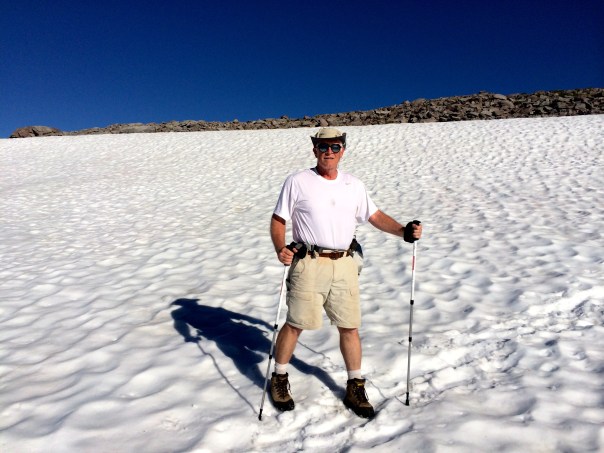
Snow on hike to Old Snowy

View of Mt Rainier from Goat Rocks
When you have tired of the PCT portion of the loop take the short trail link over to Lilly Basin and continue on to Goat Lake.
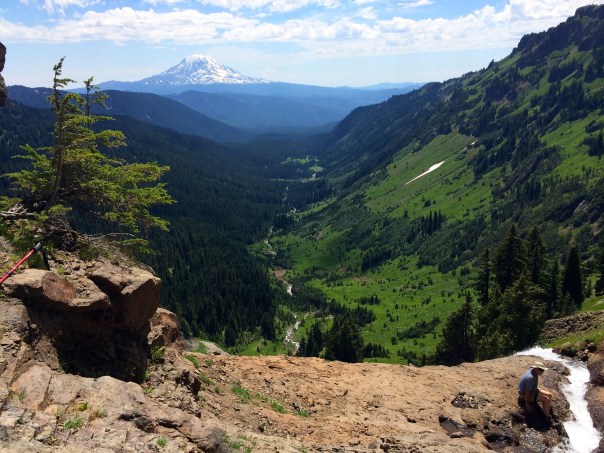
Valley below Goat Lake 2014
This video of the falls below Goat Lake tries to convey the enormity of the area.
The campsite below Goat Lake is primo, however, there are many spots up and around Goat Lake.

Mt Adams Sunset
The loop continues on the Lilly Basin Trail joining the Goat Ridge Trail but you may want to continue a bit further on the Lilly Basin Trail up to Hawkeye Point. The return is all down hill and you do tend to run into serious bug stretches as you reenter the trees.
Prep for Annual Backpacking Trip 2014
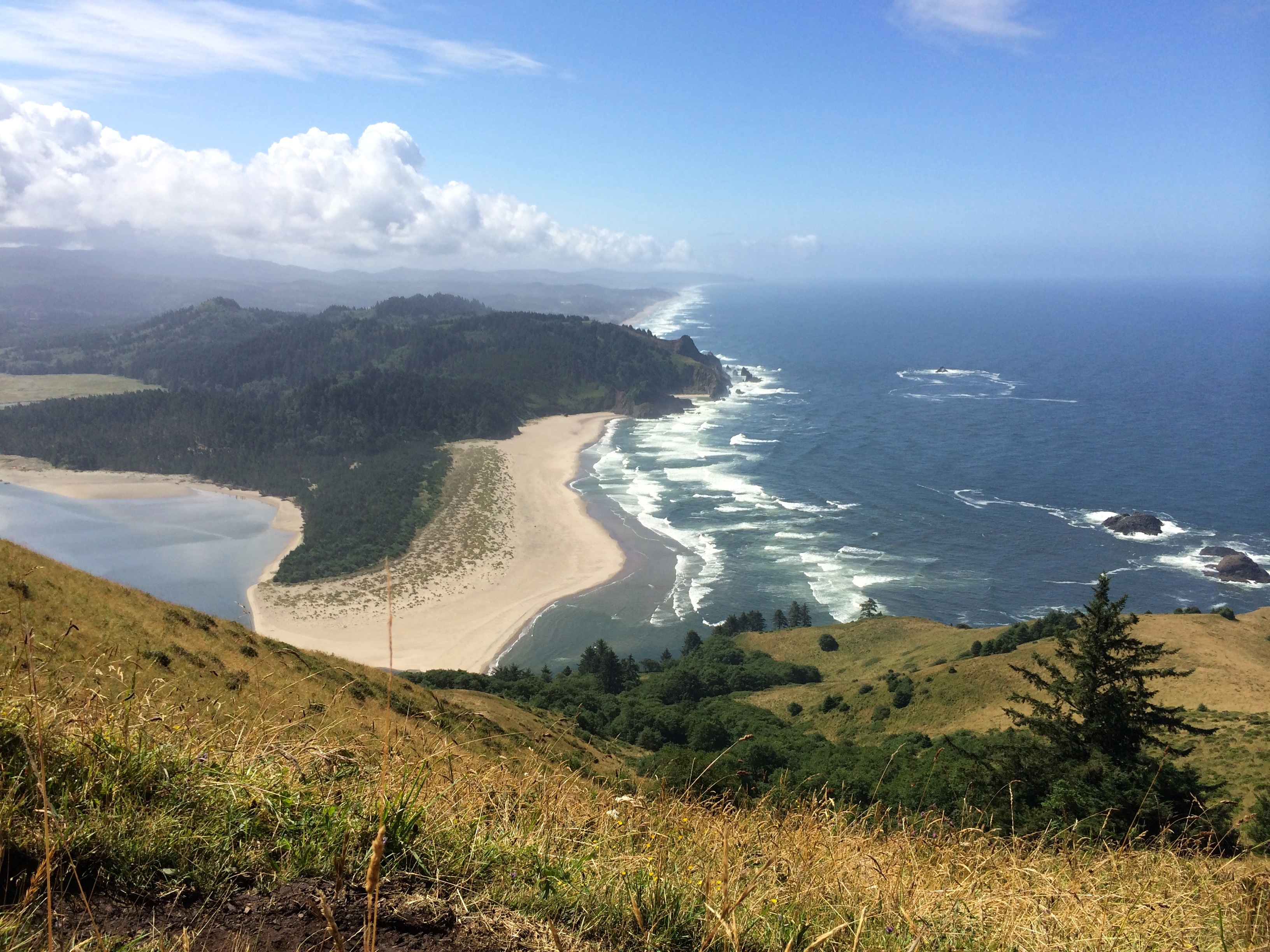
Cascade Head Oregon
I leave tomorrow for my annual backpacking trip. This will be five days in the Goat Rocks Wilderness Area in Washington. Going totally offline is a good thing to do. Last time I did this I remember having over 1000 emails to deal with, but life goes on without us. The backpack is ready weighing in at about 37 lbs and I am in fairly good shape having been able to do a few short mountain day climbs this last week. The Cascade Head hike offers spectacular coastal views with a very steep vertical climb. Hart’s Cove ends out on the coast in a secluded cove but it is all down hill (1000 ft vertical) to get there. When I return I will post a trip report to the Portland Hikers Website. Here is a trip report from my first backpacking trip to the Three Sisters Wilderness Area near Bend, OR.

Harts Cove Oregon
Cell Phone Authenticating our Identity
I was chatting with one of our professors and our conversation ventured into the importance of mobile devices. The topic related to why it was so important for Microsoft to gain a foothold in the mobile phone market and I explained to him the intricate connection between the consumer’s phone and their computing platform of choice. But I also told him that the mobile phone would someday be the most important component for authenticating identity which is critical for financial transactions. I’m not sure I knew exactly how that was going to play out but it is always fun to stimulate non-techies into imagining what the future might hold. I did tell him about how important cell phones were in Africa for providing a means of transferring money. So it was a natural assumption to connect the cell phone to the online or digital economy as a means of providing more secure form of authentication. And when you talk more secure you typically relate that to a dual form of authentication based on something you have and what something is better than cell phones. Anyways, this conversation led to being asked to give a talk on this topic for the local Rotary.
I relate this conversation as a lead in for the story today about how Apple might offer a means for how we pay for stuff. Apple is hinting that it may explore this territory of payment services and that the fingerprint authentication on the new iPhones was implemented with this in mind. But the real impetus may be that Apple has amassed the most impressive number of personal accounts, about 800 million, that are connected to a credit card. This number is huge especially when compared to the next closest, Amazon’s 237 million. And what was the trick to getting this many purchase ready accounts? Music Downloads through iTunes. Yes, the convenience of impulse buying for a song that I hear justified my synchronizing my credit card with my iTunes account. And I have been very pleased with the results; quick, efficient, receipt email, and trust. Yes trust, there has not been a significant security breach of Apple’s accounts.
So is Apple going to expand their payment services to include any online or even checkout counter transactions? Lot’s of issues that have to be worked out before that financial model is justified, but I would bet on it. I was originally thinking the mobile phone could provide an identity solution for verifying who you are using the 2 step authentication model. Apple has successfully expanded that to include biometrics which I think will inevitably be required in our insecure identity compromised world. Makes a whole lot more sense then offering a credit card and signing a receipt. Needless to say, control of the mobile phone market continues to grow in importance. The next authentication phase will probably involve scanning that chip they want to insert into our body, but I think for now we work from something that everyone wants to have on their body.
Disruptive IT for Higher Ed
The blog post by Ian Cox about his new book “Disrupt IT” motivated me to offer some reflection on the type of IT Disruption that I have needed to employ for my slice of Higher Education. I have not read his book but I can tell that I would agree with his premise that IT has become the change agent. It is easy to connect technology to why change has accelerated in recent years. But change is not accelerating in Higher Education. Be clear, we do not need to change because of technology, but it is technology that has highlighted the need for change. And that is where IT may be the perfect change agent for Higher Education.
Higher Education is still avoiding the real technology elephant in the room, the “Internet”. We deal with a whirlwind of questions about how students learn and why does college cost so much and why isn’t it about students getting jobs. Maybe we should use more technology in the classroom or software to manage our student success. But it does just come back to the fact that Higher Education no longer controls the data which is converted into information which can become knowledge for anyone motivated enough to absorb it.
OK, back to disruption. I came to Missouri S&T because I wanted to make a difference in Higher Education for the STEM segment that I feel is critical for our future. I do believe IT needs to be the change agent and doing so at such a technology dominant university is the perfect challenge. Yes, I inherited an IT service model that was catering to our traditional decades old higher education culture. And Missouri S&T is facing the same challenges stressing many public research universities in the US. Challenges of serving increased enrollment with an aging infrastructure using an outdated business model. How can IT help?
First you have to change the culture of your IT staff while also laying the groundwork to change the university’s relationship to IT. This is all done by building trust. IT staff that are working in the traditional control service model may be reluctant to breakout of that comfort zone. IT staff love to be needed and that old model offered that, but what about innovation? IT staff should be the innovation leaders or at least they should want to be. I believe that path to a successful IT culture change has to build from IT being innovative and gaining pride from how that innovation can impact the university. And the key to unlocking that innovative spirit in your IT staff is to show them that you mean it. Invest in their ideas or at least let them own your ideas. And above all, assure them that it is OK to fail.
Gaining trust from your university is more tricky since some of your customers are very content with the old IT support model which may still support their outdated business model. However, the important customers are the faculty. The reality for them is that their job has only gotten more difficult to perform. Teaching loads have not decreased and research funding is more and more scarce. IT offering support for teaching load tends to point toward the utilization of technology and exploring online delivery. But IT does not need to push any of that, IT just needs to offer assistance in utilizing it. IT does not need to push online learning to secure their value in EdTech support. They just need to offer support, faculty need the help, leave the politics of course delivery to the Provost. And IT support for research needs to come again as the assistance model. A researcher used to get a grant that outfitted their lab with technology that was managed by a grad student and had enough fluff to allow some breathing room. Today it seems like more time is spent submitting grant proposals then actually fulfilling the research of the successful grants. IT has to find a way to be a trusted partner so that researchers can sell that support to win their grants. This is a budget dance, but IT has to find a way to free up researchers to actually do research.
When IT appears to be achieving positive repositioning, some strategic disruption can put it all together. IT departmental reorganization will inevitably be needed, but turn it into an opportunity. Gain some visibility for IT on campus by offering support to a much needed service. That might be a service to students it might be supporting another service provider like the library. Don’t lead with a software service disruption, that will come later and will probably be IT’s greatest contribution, but total trust is needed for that.
Google Glass Review
I guess I am a curious geek, I had to checkout Google Glass the same way I had to have an Apple II in 1979 and an iPhone when they came out. Of course I justified the $1500 Glass price tag because many at the university were itching to get their hands on them as well. I have been exploring Glass for 4 days now and I have concluded that this wearable technology is going to be Big. Not Big because of efficiency or usefulness. Big because they are just really cool.
First to catch everyone up on what Google Glass is – checkout this ABC Technology Video by Joanna Stern.
Unlike the Cyborg like appearance Google Glass generated for her wearing them in the city, I have yet to be asked about them after numerous encounters with strangers in Rolla, MO. However, it has been 6 months since Joanna first shocked people with them. The other side of that coin is that I was pleasantly surprised to discover that they feel fairly normal and do not interfere with your normal vision. You can easily forget you have them on until you want to take photo or ask Google for information.
Google Glass is definitely in Beta testing mode. If you are expecting lot’s of administrative instructions forget it. Your greatest source for answers is the heavily trafficked user forums or as Google refers to them as Explorers Community. A real downside right now is the lack of an IOS app to allow you to connect with your iPhone or iPad but that battle will be waged later when Glass goes public. Since I can’t tether my Glass to an Android Phone I walk around with my AT&T MiFi to provide Internet access, what a geek.
My first intentional public display of Glass came last night for our IT Christmas party, which by the way was great. Santa couldn’t make it but Mrs Claus and an Elf showed up to pass out gifts to the children. So I had a captured audience of IT folks and their families. First observation was that my older staff were more reluctant to checkout the Glass then the younger ones. The kids were the most interesting. It seemed like the teenagers were interested but it did not click for them as quickly as it did for the preteens.
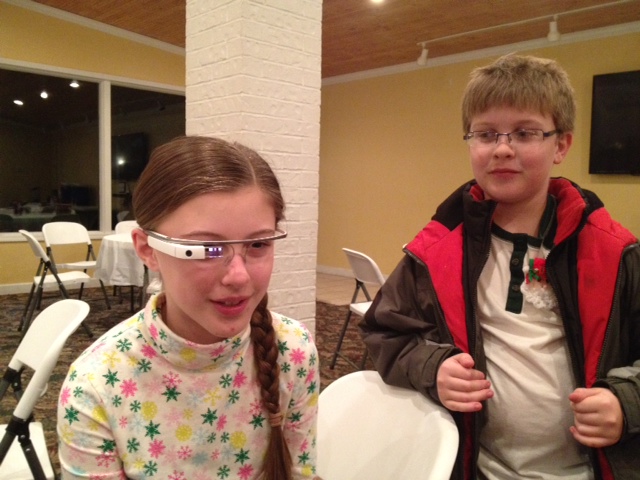
Kids First Exposure to Google Glass
Kids from say 6-12 immediately got it and you could see their minds race with imagination. Notice photo of brother waiting on his sister for a try. He quickly figured out how to ask Google about “Hunger Games”. I was told that the boy never stopped talking about the Glass the rest of the evening and he couldn’t wait to tell his teacher the next day.
I will continue to play with Glass through the Holiday’s but will then start loaning them out to the growing list of Geek volunteers. The bottom line is that there will be new battles over control of wearable technology but market share of mobile devices will be important. Get ready for an Apple Google clash over Glasses.
Producing “Big Data” Scientists
I wish that I would have attended the Big Data in Higher Education Conference at SUNY last week. Harper Reed @harper, former Obama campaign CTO, was the keynote speaker and according to the Chronicle review, he told it the way it is. ‘Big Data’ is Bunk. His message highlighted how the Obama campaign utilized analytics from “Big Data” to help win the election. And it sounds like he presented how higher education could take advantage of this technology but that the vendors for “Big Data” solutions were using the term “Big” to mostly sell big computers. I agree that we don’t need huge computer resources to utilize “Big Data” analysis concepts. However, we are going to build a Big Data system that probably leans toward an In Memory model. I also realize that higher education rarely utilizes “Big Data” effectively for business or academic advantages but that is a discussion of its own.
Harper also offered some advice in another session, “Data Scientist: the Sexiest Job of the 21st Century,” which hit home for me here at Missouri S&T. We are currently building a new cross discipline program around the buzz term “Big Data”. We have our Business and Information Technology, department contributing to the client end including the tie in to ERP. We have Computer Science and Computer Engineering focusing on the infrastructure, data models, analytic algorithms, programming and visualization needed to produce the kind of data scientists that Harper said he wants to hire. This is why I came to S&T, to help a world class STEM institution create products that can help change the world.
Comments from Disney Educause Week
The best place to hold an Educause conference is in the happiest place on the earth, Disneyland, especially during a week of sun and 70’s. This is the time of year when all collegiate techies compare notes, renew friendships and chart the future of higher education. Educause keynote speakers try to shock us, console us and then inspire us. But there rarely are any roadmaps provided for us to follow. We know we must continue to increase our WiFi density, move stuff to the cloud and relax our outdated control policies. But mostly we network with our peers.
Trends discussed at Educause that I have interest and insight had to do with the future of ERPs and LMSs. Lot’s of my colleagues are looking for answers to their ERP dilemmas. And it seems like many Blackboard customers are planning their exit strategy to a Canvas or Moodle. And in the background are all of the solutions that will insure that teaching and learning takes place more effectively. This all threatens our old school technology empires but can generate great excitement for the new school.
Yes we do need to get our act together with respect to running the business of higher education. We drank the kool-aid served us by corporate ERP solutions that we were told could be adapted to higher education. And they have been adapted at a ridiculous price. However, did we ever receive serious advice to simplify our business processes? I was recognized at the Oracle booth as the poster child champion for the most successful PeopleSoft implementation they have seen. But not for the most profitable. When I implemented PeopleSoft 3-4 years ago I forced business process change to adapt to the base system because of budget and talent constraints. But that was just a consolidation of best practices for higher education. We did not have an opportunity to redesign our business. So my advice to all of us looking for solutions to our ERP predicaments; maybe we should investigate a more effective way to administer the business of higher education first. We might be shocked at how easy it could be to adapt an ERP to a business process that made sense.
And what about Learning Management Systems? My only comment is to again step back and realize how simple LMSs are. I guess we took the opposite approach with them. We have a fairly good business process that we have over complicated by computerization. Maybe it was because we created them but were taught by our corporate ERP vendors how to commercialize them. Bottom line is that an LMS is nice to have but is not critical for teaching and learning. There are plenty of tools that can help a professor to be more efficient but no university should be held hostage to a single tool. Hmmm, that is sort of the academic way, we do all the work and another business entity charges us for it.

3-D Printed Smartphone Cover
So enough of the trials and tribulations of the season. What about some bright spots like my being ranked the 38th most Social CIO or how cool our rollout of 3-D Printing for all of the students at S&T has been.
Research Technology Day

A benefit that I thoroughly enjoy from being the CIO at Missouri University of Science and Technology is the opportunity to promote, support and participate in research activities. The capstone event that represents IT’s involvement with research is our “Research Technology Day”, RTD, that takes place next week, September 9-10. Pulling off a significant conference such as this is a tremendous amount of work but we must persevere because what good is research if we don’t share it with others.
This year’s RTD takes on additional value for me because it is my first opportunity to place my mark on our research support goals. But it also allows me and my research support team to gauge where our state university system wants us to be and where our neighbors and peers are at. My impressions and observations so far:
It is easy to generate interest in a research conference with your peer IT support colleagues. It is difficult to generate interest within in your own research community. However, that is just a communications problem, once you breakthrough there is plenty of interest. Then it becomes a race to keep up with the demand and pull it off. This year’s RTD will be great; awesome speakers, interesting research topics, good food and real “Fireworks”. But it will also be important for aligning the future of our institution’s research strategy with the changing landscape of today’s higher education research environment. The overall motivator – this along with teaching is the major reason why we exist.
Update: Opening night of the Conference was great. I don’t think I have ever seen a better fireworks display. Way cool being showered overhead with such a show in the middle of campus. The S&T Pyro team offers us a unique skill set. Here is a video of the Display
3D Printing for our Students
We have just pulled the trigger to offer 3D Printing to all of our students here at Missouri S&T. It was not difficult to confirm that 3D Printing is about to explode in use and availability so what better venue to make it available then at a university full of engineering and science students. Plus I have faculty who are renown for their work with 3D printing or Additive Manufacturing as they call it. They have provided me with the advice I needed to select the appropriate 3D printers for student access.

Stratasys 3D Printers
I will write another post when we open our new 3D printing service in a few weeks but for now I will give you the basics of our plan. We bought 2 Stratasys uPrint SE Plus 3D printers, the same models that UPS just ordered for their leap of faith into this business venture for their select stores. We will place these printers in our library print media area where we can manage them with IT tech support students. We have a lot to learn about the business process but it appears we can let our students pay for the objects printed with their PaperCut account. All the students need to do is submit their 3D drawing file and the uPrint CatalystEX software will help us to choose the most effective positioning and calculate the materials cost. We have a regular and an ultrasonic washer with a good sink area for cleaning off the lattice support, so here we go. The goal is to make this printing available to everyone at the most affordable price. We know that the increased access to the printers will be beneficial to our engineering design classes and I am hearing that it will be invaluable for supporting our graduate student researchers so I am hopeful that this will turn out to be a wise decision.
Will 3D Printing Change the World?
Video story by Springfield, MO, KY3 TV’s Lindsey Henry
New Era of Data Visualization is Upon Us
Big Data is a term being thrown around a lot lately, probably because it is so easy to acquire or generate huge datasets for just about everything. And when I hear scientists discuss this trend the conversation always seems to end up with the need for better tools to interpret or visualize the data. As the new CIO of Missouri S&T I inherited a data visualization project that was started by my Research Support Services group to help one of our geophysicist’s interpret his data. At first it was help with running ParaView, an open-source, multi-platform data analysis and visualization application. Projection solutions were setup and a front end data filtering and a loading tool was created. Enough work to show real potential and earn the team of students nice recognition at last year’s SuperComputing 2012 Conference.
Last May as a new team of students was coming on board for summer work we took the data visualization system to the Great Plains Network Conference where it was again highly acclaimed. The system, now called

Visualizing Four Dimensions in Rolla or V4DiR is now anchored by the front end software referred to as Transformer. This front end, as explained by Nick Eggleston, a junior computer science major from Maysville, Mo., who leads the project is a computer program to allow the software to show how data progresses over time. The program will also allow users to manipulate the format of their data and combine similar sets of data. The recent article reprinted in Science Today on V4DiR explains more.
I throw out all of this buildup about V4DiR to announce that I believe we are ready for a new era of data visualization. One that might actually justify all of those expensive video display monuments that have primarily been used for marketing. Maybe the concept of the virtual immersion CAVEs are truly ready for prime time. My investment has been minimal up till now but I am ready to invest heavily when I validate the most effective technology for this new era. We hope to explore this in more detail at our upcoming Research Technology Day at S&T. Join us, registration is free.


 The Adventure Continues